Build a Web3 Beta Tester Program That Works

Before you even think about a mainnet launch, you need to talk about beta testing. A beta tester program is where you hand-pick a group of users to take your product for a spin, giving you the real-world feedback you need to iron out the kinks and smooth over the rough edges. It’s a foundational step for any serious Web3 project, turning your earliest supporters into a community that builds with you.
Why a Beta Program Is Your Secret Weapon in Web3

Let's be real—launching in Web3 is brutal. A single smart contract bug or a confusing UI can kill your reputation before you even gain traction. This is exactly why a solid beta program isn't just a "nice-to-have." It's your survival kit.
Think of it as your very first, most genuine marketing push. It’s your chance to turn curious onlookers into die-hard advocates who are genuinely invested in what you're building. These people aren’t just hunting for bugs; they're your first line of defense, your unofficial focus group, and your most vocal champions, all in one.
Go Beyond Simple Bug Hunting
Sure, squashing bugs is a huge part of it, but the real magic of a beta program goes way deeper. It's a safe space to test your biggest assumptions and start building that critical community from the ground up.
- Generate Authentic Social Proof: You can't buy the kind of credibility that comes from real users sharing genuine, positive experiences. A great beta program kickstarts organic buzz that no ad campaign can ever match.
- Prevent Costly Post-Launch Disasters: Finding a critical flaw after you've launched on mainnet is a full-blown nightmare. Early feedback lets you find and fix those showstoppers when the stakes are low, saving you a ton of time, money, and stress.
- Build a Community of Co-Builders: When you bring users in early, you give them a real sense of ownership. They stop seeing themselves as just "users" and start acting like part of the core team, fighting for the project's success.
A well-run program turns your first users into your most powerful growth engine. They provide the raw, unfiltered feedback needed to build a product that people actually want to use, not just one you think they want.
The Growing Importance of Pre-Release Testing
The idea of structured testing isn't just a niche concern anymore; it's a massive industry. The global beta testing software market is set to be worth around $9.3 billion in 2025.
And it's not slowing down. Projections show it exploding to $33.8 billion by 2035, which tells you just how seriously everyone is taking quality assurance. This trend makes one thing crystal clear: investing in a robust beta program is non-negotiable for product quality and long-term success. You can explore more data on the beta testing market growth to see just how big this is becoming.
Finding and Onboarding the Right Testers
Let's be real: your beta program's success boils down to who you invite to the party. Just throwing a generic "sign up here" link into the void is a recipe for attracting low-effort participants who are only there for a quick airdrop. A strong program is built by carefully picking the right people—those who are genuinely fired up about what you're building and can give you the kind of feedback that actually matters.
This isn't about filling seats. It's about building a small, dedicated crew. To do that, you need a compelling application process that acts as a natural filter, pulling in your ideal candidates while gently turning away the ones who aren't a good fit.
Crafting Your Tester Personas
Before you can find your A-team, you have to know who you're looking for. Don't think in broad strokes. Get super specific and create detailed tester personas that mirror your product's real-world users.
- DeFi Power Users: These are the people who live in Etherscan, understand complex protocols, and can probably explain impermanent loss better than you. They’ll stress-test your economic models and spot tiny UX snags a novice would never see.
- NFT Collectors: This group gets the culture. They know what makes a minting experience feel special versus what makes it feel clunky and cheap. Their feedback on anything NFT-related is pure gold.
- Crypto Newcomers: Never, ever underestimate a fresh pair of eyes. These testers represent your future mainstream users. If they get stuck trying to connect their wallet, you’ve got a massive problem to fix before you go live.
Thinking in personas helps you assign the right tasks to the right people. You wouldn’t ask a newcomer to test a complex staking mechanism, but they’re perfect for giving you raw, unfiltered feedback on your sign-up flow.
Sourcing Testers From Their Native Habitats
Spamming your beta program link across every Web3 channel isn’t just ineffective, it’s annoying. A much better approach is to go where your target personas already hang out. This is less about mass promotion and more about authentic engagement.
Think about where these groups actually spend their time:
- Targeted Discord Communities: Find the Discord servers for projects similar to yours or those focused on specific niches like NFT art or regenerative finance. Actually participate in the conversation before you even think about dropping a link.
- Specific X (Twitter) Threads: Jump into conversations with the influencers and builders your ideal testers already follow. Add real value to threads about topics that are relevant to your project.
- Niche Telegram Groups: Find those Telegram groups where the serious discussions are happening. Look for channels focused on L2s, a specific blockchain ecosystem, or game dev if that's your world.
The goal is to recruit a community, not just a list of addresses. People are way more likely to give you high-quality feedback when they feel like they were personally invited from a community they trust, not just sniped by a random ad.
Designing an Application That Filters for Quality
Your application form is your gatekeeper. It needs to be interesting enough to attract the right people but tough enough to weed out the ones who aren't serious.
You’ve got to ask questions that reveal someone's actual experience and what drives them.
- Experience Level: Get a sense of their Web3 comfort zone. A simple multiple-choice question like, "How would you describe your crypto experience?" with options from "Just getting started" to "I regularly interact with smart contracts" works wonders.
- Motivations: Find out why they care. An open-ended question like, "What excites you most about our project and why do you want to be a beta tester?" can tell you everything you need to know about their passion.
- Past Contributions: Ask if they’ve done this before. This helps you spot seasoned testers who know how to give feedback that’s actually useful. And if they're brand new? That's great, too—they might be your perfect "Crypto Newcomer."
Once you have your team, knowing how to collect and process their feedback is the next big step; diving into these 10 Essential User Experience Testing Methods can seriously sharpen your process. And if you're on the other side of the fence, check out our guide on how to become a beta tester to see what projects are looking for. This whole process ensures you start with a rock-solid foundation for a killer beta program.
Designing Quests People Actually Want to Do
A great beta program is powered by quests that are actually engaging, not just a list of chores. The whole point is to create a smart blend of on-chain and off-chain tasks. This way, you get the critical data your dev team needs while keeping testers genuinely invested and excited to participate.
Let’s be honest, the days of "connect wallet" or "follow us on X" are over. Those tasks give you practically zero useful information. The real magic happens when you ask testers to do something that feels both valuable to them and insightful for you.
Crafting High-Impact On-Chain Quests
On-chain quests are your first line of defense. This is where you battle-test your protocol's core functions, getting direct, verifiable feedback on your smart contracts and user flows—all in a safe testnet environment. The trick is to design tasks that zero in on the specific features you need to validate before they go live.
Here are a few ideas to get you thinking:
- Liquidity Pool Stress Test: Have testers add a specific amount of liquidity to a new testnet pool, then pull half of it out 24 hours later. This is perfect for uncovering obscure bugs in your deposit and withdrawal logic.
- NFT Minting Gauntlet: Design a multi-step quest where users have to mint a series of three distinct test NFTs, each with a unique trait. It's a fantastic way to spot potential vulnerabilities or UI clunkiness in your minting process.
- Targeted Token Swap: Ask testers to swap an exact amount of Token A for Token B, but add a condition—like only when gas fees are below a certain gwei. This tests how well your dApp integrates with price oracles and performs under specific network conditions.
The best on-chain quests mimic what real users would do. They push your protocol to its limits and help you find those weird edge cases you’d never catch internally. This gives you a chance to fix things before they affect real users and real money.
Thinking about who your testers are can help you design better quests. Are they seasoned degens, NFT collectors, or total newcomers? Tailoring tasks to different personas gets you much more targeted feedback.
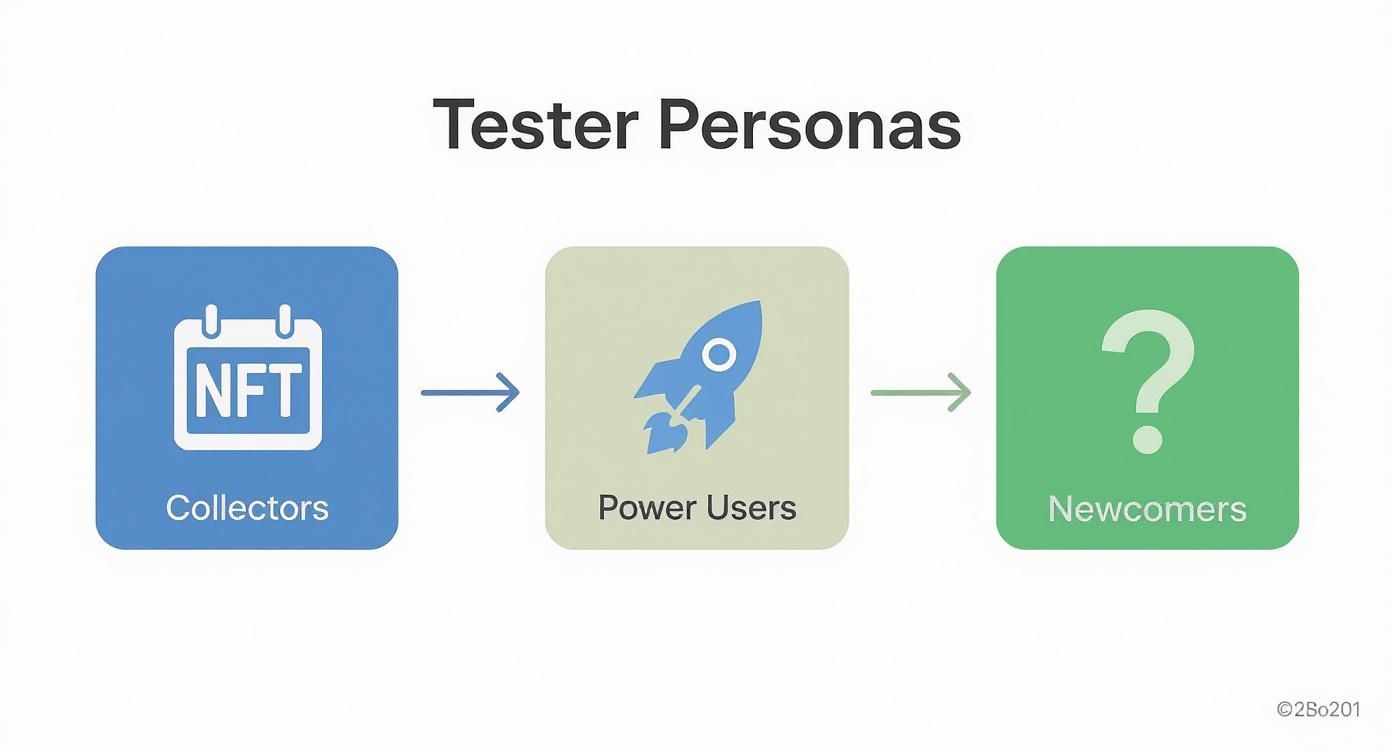
Knowing who you're talking to means you can assign tasks that play to their strengths, which ultimately gets you the most valuable insights.
Generating Real Buzz with Off-Chain Tasks
While on-chain actions test your tech, off-chain quests are all about building your brand and your tribe. These tasks are meant to generate authentic social proof, gather rich, qualitative feedback, and turn your testers into genuine advocates. The goal is creativity and real engagement, not just mindless shilling.
So, instead of a generic "share our project" tweet, try getting more specific.
- Create a Tutorial Video: Ask some of your most active testers to record a short 60-90 second video explaining how to use a specific feature. This gives you amazing user-generated content and, more importantly, shows you exactly where people get confused.
- Start a Feedback Thread: Prompt testers to kick off an X thread with their honest, unfiltered thoughts on their experience. Encourage them to tag your project and use a specific hashtag to track the conversation. It sparks public discussion and proves you're a team that listens.
- Write a Detailed Blog Post: For your true power users, offer a bigger reward for writing a full-blown blog post reviewing your platform. This nets you incredibly deep feedback and creates long-form content that can attract new people to your ecosystem.
A great example of this is how projects like Block Party App used community-powered quests to build serious launch momentum. You can read more about how they built an engaging launch strategy that was all about user participation.
On-Chain vs. Off-Chain Quest Ideas
To help you get started, here's a quick comparison of different task types to inspire your quest design. Think about the goal and complexity level that best fits what you're trying to achieve at each stage of your beta program.
| Quest Type | Example Task | Primary Goal | Complexity Level |
|---|---|---|---|
| On-Chain | Mint a testnet NFT | Test smart contract execution & UI | Low |
| On-Chain | Provide liquidity to a specific pool | Stress-test deposit/withdrawal functions | Medium |
| On-Chain | Execute a multi-step token swap | Validate complex user flows & integrations | High |
| Off-Chain | Post a "proof of test" screenshot | Generate social proof & visual engagement | Low |
| Off-Chain | Write a detailed feedback thread on X | Gather qualitative insights & spark discussion | Medium |
| Off-Chain | Create a video tutorial for a new feature | Source user-generated content & identify friction points | High |
Mixing and matching these quest types keeps things interesting for your testers and ensures you're gathering a well-rounded set of data points—from contract performance to user sentiment.
Ultimately, a successful beta program is a two-way street. When you design quests that are insightful for your team and genuinely rewarding for your testers, you create a powerful feedback engine. This not only strengthens your product but also builds a loyal, ride-or-die community from the very beginning.
Getting Smart with Rewards and Task Verification
So, you've got a beta program. It starts small, maybe 50 dedicated testers. But then it catches on. Suddenly you’re looking at 500 people, and the manual work of checking every single quest submission becomes an absolute nightmare.
This is a classic growing pain, and it’s the fast track to burning out your team. Manually verifying hundreds of submissions isn’t just slow; it’s a soul-crushing task that grinds everything to a halt. This is the exact moment when you need to bring in automation.
Tools like Domino were built for this. Think of it as an automated co-pilot for your community manager. It can instantly check on-chain actions by looking at a transaction hash or verify off-chain tasks, like seeing if someone actually used the right hashtag in a tweet.
The result? Your team gets to ditch the boring admin stuff and focus on what they do best: digging into the genuinely valuable, human feedback that will actually improve your product.
The Magic of Instant Verification
Automation is more than a time-saver—it’s about keeping the energy high. When a tester completes a task and gets that instant "Quest Complete!" notification, they feel seen. They feel rewarded. And they're much more likely to jump right into the next task.
Now, picture the opposite. A tester slogs through a tricky on-chain quest, submits their proof, and... nothing. Silence. Days later, you finally get around to approving it, but their initial excitement is long gone.
Here’s how automated tools completely flip that script:
- On-Chain Stuff: Someone stakes your testnet tokens. The platform pings the smart contract, sees their wallet address in the event logs, and—bam—task complete. No human intervention needed.
- Social Tasks: You ask for a retweet of a big announcement. They drop the link, and the system instantly confirms their account retweeted the correct post. Done.
- Creative Quests: Even for subjective tasks like creating a tutorial video, AI can do the first pass. It can check for things like video length or specific keywords before flagging it for a final, quick look from a team member.
That immediate feedback loop is the secret sauce to a beta program that feels alive and engaging.
Building a Reward System That Actually Works
Verifying tasks is half the battle; the other half is rewarding them properly. Get this wrong, and you can either kill your community's motivation or accidentally drain your treasury before you even get off the ground.
The goal is to build a smart, tiered system. You want to reward your absolute best contributors without giving away the farm. Forget the one-size-fits-all airdrop model. A smart mix of different rewards is far more powerful and sustainable.
A killer reward system does more than just pay people. It makes your top contributors feel like a core part of the team. It’s your way of saying, "We see the incredible work you're doing, and it matters."
This is how you get your best testers—the ones finding the gnarliest bugs and writing incredibly detailed feedback—to stick around and keep contributing.
The Right Mix: Tangible and Intangible Rewards
The best programs I've seen always blend different types of rewards. Why? Because people are motivated by different things. For some, it's all about the potential airdrop. For others, it's about status, access, and being on the inside.
Here’s a breakdown of a balanced reward structure:
| Reward Category | Specific Examples | Why It Works |
|---|---|---|
| Token-Based | Future token airdrops, stablecoin prizes for bug bounties | Directly connects their efforts to the project's success. |
| NFTs & Swag | Exclusive commemorative NFTs, in-game items, POAPs | Gives them a unique badge of honor and a sense of belonging. |
| Access & Status | Whitelist spots for a future mint, unique Discord roles | Plays on the power of exclusivity and social proof. |
| Community Perks | Access to a private dev channel, direct chats with founders | Makes them feel like true insiders and valued advisors. |
For the community-focused stuff, using something like a Discord raffle bot can be a really fun way to give out special roles or prizes, adding a little bit of gamification into the mix.
By mixing these incentives, you create a system where anyone who puts in real effort gets rewarded, but your top 1-5% of testers get something truly special. This tiered approach is what fuels a high-performance beta program that delivers insane value without breaking your budget.
Weaving Your Program Into Your Community
Your beta tester program shouldn't be some separate, walled-off event. For it to really take off, you have to knit it directly into the fabric of your community. It needs to live and breathe where your most dedicated users already hang out—places like Discord and Telegram.
When the program feels like a natural part of your community, signing up and participating becomes a no-brainer. Engagement goes through the roof. This is about more than just dropping quest links in a channel. It’s about creating an experience where updates, role assignments, and shout-outs happen automatically, right inside the apps your testers use every single day.
Making It Seamless on Discord and Telegram
The goal here is to make participation feel completely effortless. If a tester has to constantly jump between your dApp, a separate quest platform, and back to Discord, you're creating friction. That kind of friction kills momentum fast. The trick is to bring the program to them.
This is where things like webhooks and bot commands become your secret weapons.
Picture this: a tester grinds through a tough on-chain quest. The second they finish, a bot announces their achievement in a public channel and automatically gives them a shiny new "Elite Tester" role in Discord. That little touch provides instant public recognition and makes them feel valued, all without you lifting a finger. If you need a primer, building a professional Discord server is a great place to start learning the ropes.
Here’s how you can make it happen:
- Automated Announcements: Use webhooks to push real-time notifications for new quests, project milestones, or leaderboard updates directly into your main community channels.
- Role Assignments: Instantly grant special Discord or Telegram roles to testers who hit specific tiers or knock out high-value tasks. This creates a clear and coveted status symbol.
- Direct Notifications: Send personalized updates or reminders through bot DMs. This keeps testers in the loop without spamming public channels.
Focusing on Metrics That Actually Matter
Once your program is up and running, you need to figure out if it's actually working. It's so easy to get distracted by vanity metrics that look impressive but tell you nothing about your product's real-world performance. The number of sign-ups is nice, but it's not the real story.
The true gold of a beta program is the quality of the data it generates. You have to track Key Performance Indicators (KPIs) that give you an honest, unfiltered look at your product and how deeply your testers are engaged.
Forget vanity stats like total participants. The most important metrics are the ones that reveal the quality of feedback and the true level of user engagement. These are the numbers that guide your product decisions.
Set up a simple dashboard—honestly, even a shared spreadsheet will do—to track the handful of KPIs that will actually help you improve. This data is what you’ll build your entire pre-launch strategy on.
Your Core Beta Program KPIs
To get a clear picture of your program's health, zero in on these essential metrics:
- Bug Report Quality: Don’t just count how many bugs are reported. That’s a rookie mistake. Create a simple 1-5 scoring system based on how detailed and reproducible each report is. A high average score tells you your testers are giving you feedback you can actually act on.
- Task Completion Rate: What percentage of testers who start a quest actually finish it? A major drop-off on a specific task is a huge red flag. It’s screaming at you that your instructions are confusing or there’s a show-stopping bug.
- Feedback Sentiment Analysis: Get a feel for the overall tone of the written feedback. Are people generally excited, frustrated, or just confused? This gives you a gut check on the user experience that raw numbers can't.
- Tester Retention: Of the testers who finished a quest in week one, how many came back for more in week two? High retention is the ultimate signal that you've built an engaging and rewarding program.
This shift toward quality over quantity is happening across the industry. The beta testing software market is on track to hit as high as USD 11.66 billion by 2033, and that growth is fueled by a simple truth: high-quality early feedback is a critical investment, not an optional expense. By tracking these core KPIs, you’ll know your beta program is delivering the goods you need to launch with total confidence.
Common Questions About Web3 Beta Programs
Even with the best-laid plans, you're going to have questions when you spin up your first Web3 beta program. It's just part of the process. Let's walk through some of the most common ones we hear from teams who are right where you are now.
Getting a handle on these points early on will save you a ton of headaches later.
How Many Testers Do I Really Need?
Everyone asks this, but there's no magic number. A great starting point for a new project is somewhere between 50 to 200 truly active testers.
That range is the sweet spot. It's big enough to get diverse feedback and spot recurring bugs, but small enough that you won't need a huge team just to manage the community.
Pro Tip: Always, always go for quality over quantity. A tight-knit group of 50 testers who give you detailed, thoughtful feedback is worth more than 500 who just click a few buttons and ghost. You can always open the doors to more people later.
What Are the Biggest Mistakes Projects Make?
We've seen it all, and honestly, most teams run into the same handful of problems. It's almost a rite of passage.
The most common pitfalls are:
- Confusing Task Instructions: If your quests are vague, the feedback you get will be just as useless. It just frustrates everyone.
- Weak Rewards: Your testers' time is valuable. If the incentive isn't worth their effort, your best people will just leave.
- Radio Silence: Nothing kills morale faster than a team that doesn't engage. Don't just post tasks and disappear.
- Manual Verification Nightmare: Trying to check every single submission by hand is a surefire way to burn out your team and bring the whole program to a crawl.
The absolute biggest mistake, though? Not creating a space where people feel safe giving real, honest feedback. If testers think they'll get shade for being critical, you'll only get praise—and that helps no one.
How Should I Handle Negative Feedback?
You should treat it like gold. Seriously. Tough, critical feedback is the most valuable thing you'll get out of a beta program because it uncovers the exact problems that could sink your public launch.
Your number one job is to make people feel safe being brutally honest.
When someone drops a bombshell of criticism, thank them for it. Publicly. Acknowledge the issue they found and, if you can, let them know how you're thinking about fixing it. Never, ever get defensive. Showing that you actually listen to and act on criticism is the fastest way to build a die-hard community.
Ready to stop verifying tasks manually and start building a high-impact beta program? Domino provides the no-code toolkit to design, automate, and scale your quests in minutes. Launch your program with Domino today!