How Do You Get Airdrop Rewards in Crypto

So, how do you actually get your hands on airdropped crypto? The short answer is to get in early. Start actively using new crypto protocols before they launch their own token. This usually means things like swapping tokens, providing liquidity, or just being an active member of their community to prove you were there from the beginning.
What Are Crypto Airdrops, Really?
Think of a crypto airdrop as a clever marketing move. New blockchain projects use them to get their tokens into the hands of as many people as possible, right from the start. Instead of selling them, they give tokens away for free to users who tick certain boxes. It's a fantastic way to build a decentralized community overnight, generate some serious buzz, and thank the early believers for their support.
The magic behind it all is something called a “snapshot.” The project picks a specific date and time and takes a snapshot of the blockchain, recording every wallet address that has interacted with their protocol up to that point. If your wallet met their criteria before that snapshot, you’re in. It's essentially a loyalty program for the crypto world.
The Power of Being an Early Adopter
One of the most exciting parts of airdrop hunting is the retroactive claim. This is when projects reward you for things you’ve already done, sometimes months or even years in the past.
Uniswap is the legendary example here. They essentially wrote the playbook by airdropping their UNI governance token to everyone who had ever used their decentralized exchange before a certain date. Qualifying wallets could claim 400 UNI, and for many, that turned into a life-changing amount of money. One report estimated the average claim was worth almost $30,000!
This "reward the past" strategy is now a common tactic. It encourages people to try out new and promising applications, betting that their early activity will pay off down the road.
Key Takeaway: The core strategy for getting airdrops is simple: be a genuine, active user of new platforms. Your on-chain history is your resume, proving you deserve a piece of the project's future.
Common Ways to Qualify for Airdrops
Projects look for all sorts of on-chain activities to determine who gets rewarded. Here’s a quick breakdown of the most common actions that can get your wallet on the eligibility list.
| Method | What It Means | Example Action |
|---|---|---|
| Using the Protocol | Interacting with the platform's main features. | Swapping tokens on a decentralized exchange (DEX). |
| Providing Liquidity | Adding your crypto to a liquidity pool to help facilitate trades. | Staking ETH and a stablecoin in a liquidity pool. |
| Community Engagement | Being an active and helpful member of the project's community. | Participating in Discord discussions or voting on governance proposals. |
| Testnet Participation | Using a pre-launch version of the protocol to help find bugs. | Performing specific tasks on the test network and providing feedback. |
These are the big ones to focus on. The more you genuinely interact with a protocol, the higher your chances of qualifying for a future airdrop.
And if you ever get stuck on the terminology while you're out there hunting, a good Web3 Dictionary is your best friend.
Finding Airdrop Opportunities Before Everyone Else
The biggest wins in airdrop hunting almost always come from getting in before a project blows up. If you're waiting for a big announcement on CoinTelegraph or X, you're probably already too late to the party. The real trick is to think like a digital detective, sniffing out promising protocols that haven't even launched their token yet.
This is where dedicated tracking platforms become your best friend. Think of them as your secret weapon for spotting early-stage projects that are perfect candidates for a future airdrop. They do all the hard work, collecting data on well-funded protocols with tons of user activity but no native token.
Pinpointing Pre-Token Protocols
I always start my search with data aggregators that have dashboards specifically built for airdrop hunters. They cut through the noise and give you a clean, organized list of what to look into next.
Take a look at this snapshot from DeFiLlama’s airdrop tracker, for example. It neatly lists established projects that don't have a token yet, sorting them by their Total Value Locked (TVL).
This kind of data is gold. It shows you exactly which platforms have already earned significant trust and have capital flowing through them. These are the ones most likely to launch a token to decentralize their governance. Your mission is to start using these high-potential protocols now.
Beyond the dashboards, you need to get into the weeds of the conversation. Follow well-known airdrop researchers on X (formerly Twitter) and, most importantly, join the Discord servers of projects that catch your eye. This is where you find the real "alpha"—that early-stage info that hasn't hit the mainstream yet.
My Personal Tip: Keep an eye out for projects that just closed a big venture capital funding round but are still quiet about a token. A huge VC check is often a massive signal that a token launch, and a juicy airdrop, is on their roadmap.
Time and again, the most valuable airdrops reward people who were proactively involved, not just those who held a certain NFT or token. Some hunters even dig into a project's tech score to focus their energy on quality opportunities, a strategy you can read more about on Zebpay.com. Gaining this early traction is crucial, a concept we dive into in our guide on how to get momentum for your project.
Alright, you've found a project that looks promising. Now what? The real work begins. You need to figure out what actions will actually get you on that coveted airdrop list.
The trick is to put yourself in the project team's shoes. They're not looking to reward a bunch of ghost wallets; they want to find and reward the real users who are kicking the tires and helping build their community. Your mission is to create an on-chain footprint that screams "active, early contributor."
This means doing more than just a single, lazy transaction. Let's say you're trying out a new decentralized exchange (DEX). Don't just swap one token and call it a day. Come back over a few weeks and swap different token pairs. If you’re playing with a lending protocol, don't just supply assets—try borrowing a bit, too. Show them you’re exploring everything the platform has to offer.
Crafting a Strong On-chain Resume
Think of every transaction as another entry on your crypto CV. The more varied and consistent your activity, the stronger your argument for getting that airdrop becomes. Most projects are running a hidden points system in the background, and they're looking for a pattern of genuine engagement.
Here are a few high-impact actions that often get noticed:
- Provide Liquidity: This is a big one. When you add your assets to a liquidity pool, you’re not just a user—you’re a partner helping their protocol function. It shows you have skin in the game.
- Stake Their Tokens: If there’s an option to stake, do it. Even if it's on a testnet, this shows you're helping to secure their network and believe in the project.
- Get Involved in Governance: See a proposal you can vote on? Cast your vote. It signals that you’re more than just a speculator; you're an engaged community member who cares about where the project is headed.
These are the kinds of activities that are tough for bots to replicate, making your wallet stand out as a genuine user. Once you've put in the work, the final steps are pretty straightforward, as this graphic shows.
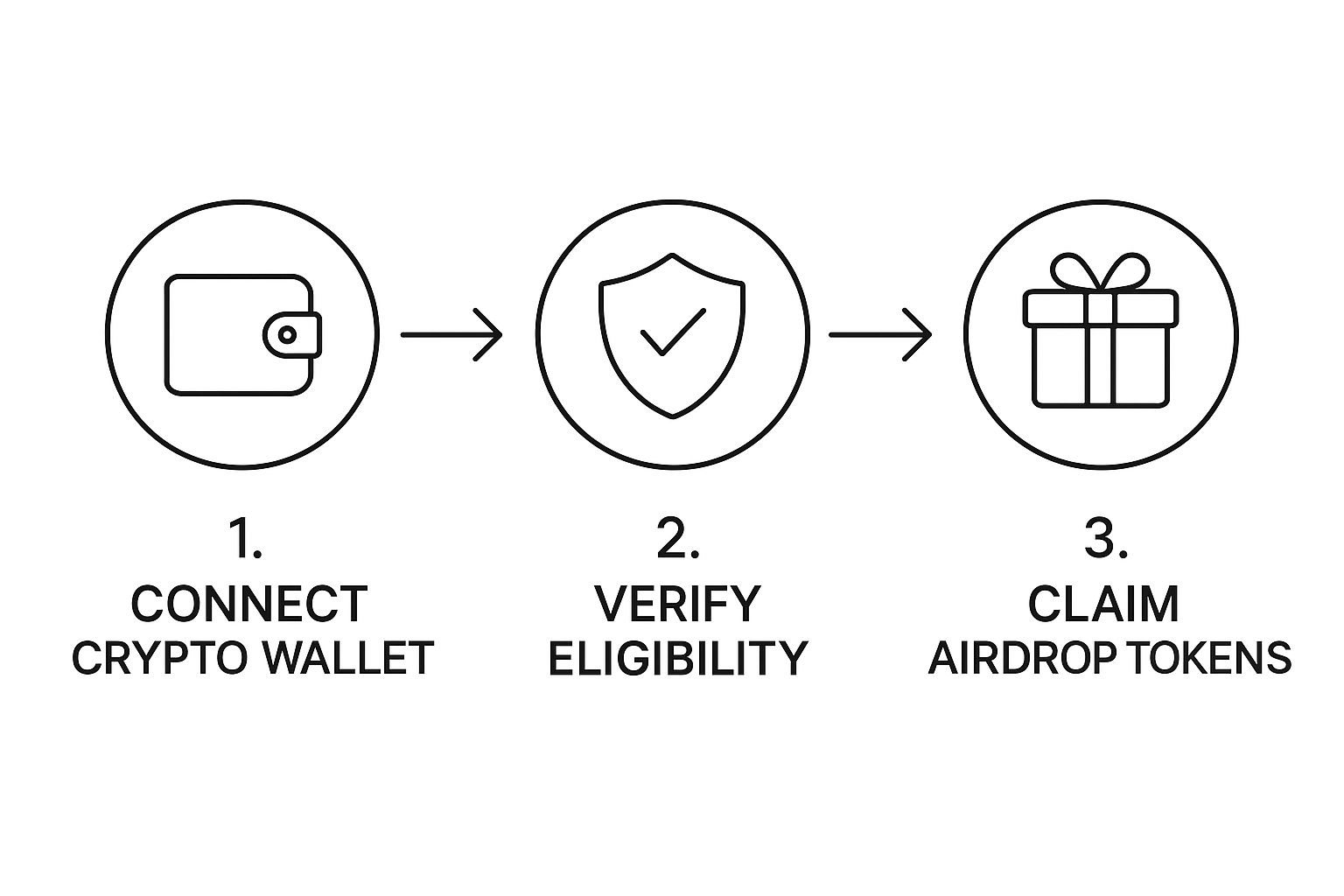
This just shows you the finish line—from getting the good news that you're eligible to actually claiming your tokens.
How These Actions Pay Off in the Real World
And trust me, the effort can be well worth it. These rewards aren't just a few bucks; they can be life-changing.
Take the Arbitrum airdrop in 2023. In the very first hour, users claimed over 42 million ARB tokens. The people who got those tokens were the ones doing exactly what we're talking about: bridging funds, making trades, and just generally being active in the ecosystem long before anyone knew an airdrop was coming. You can dig into the history of major airdrops and rewards on sites like CoinGecko.
Airdrop Hunter's Insight: It’s not just about how much you transact; it's about how often. Spreading your activity out is key. Interacting with a protocol once a week for a month looks way more authentic than cramming 20 transactions into a single afternoon and then vanishing. Tell a story with your wallet.
Your Essential Airdrop Hunting Toolkit
Being a smart airdrop hunter is less about blind luck and more about having the right gear and a solid process. Before you even think about interacting with a new protocol, you need to get your setup right for safety and efficiency.
The absolute first thing you must do is create a dedicated wallet just for airdrop farming. This is non-negotiable.
Think of it as your "burner" wallet. You wouldn't connect the wallet holding your long-term Bitcoin and Ethereum to some brand-new, unaudited app, would you? Of course not. Using a separate wallet for airdrop activities isolates the risk, shielding your main crypto portfolio from any sketchy smart contracts.
If you're new to this, a great place to start is understanding the basics by learning how to make a cryptocurrency wallet from scratch.
Staying Organized and Verifying Your Work
Once you've got your security sorted, the next challenge is keeping track of everything you're doing. You can't just fire off transactions and hope for the best. You need to verify your work on-chain, and that's where a few key tools come in.
Let’s take a quick look at the essential tools every airdrop hunter should have in their back pocket. These are critical for both finding opportunities and keeping your assets safe.
Airdrop Hunter's Toolkit Comparison
| Tool Category | Example | Primary Use Case |
|---|---|---|
| Dedicated Wallet | MetaMask, Rabby | Isolates risk from your main assets. Your first line of defense. |
| Blockchain Explorer | Etherscan, Solscan | The ultimate source of truth. Confirms your transactions are final. |
| Portfolio Tracker | Zapper, DeBank | Provides a bird's-eye view of all your assets and activities. |
This toolkit isn't just nice to have; it's fundamental to operating effectively in the Web3 space.
Blockchain explorers like Etherscan are your best friends. They are the public record that proves you did what you were supposed to do. Swapped tokens? Staked some ETH? An explorer shows you that the transaction was successfully recorded. The screenshot above from Etherscan is a perfect example of what you're looking for—cold, hard proof of your on-chain activity.
As you start farming airdrops across multiple chains, things can get messy. That's where a portfolio tracker like Zapper or DeBank becomes a lifesaver. It pulls everything into one simple dashboard so you can see all your actions in one spot.
Pro Tip: I always bookmark the official contract addresses for projects I'm actively farming. Scammers love creating fake tokens with nearly identical names to trick you. Always, always double-check the address on an explorer before you interact with it. It’s a simple step that can save you a lot of money and heartache.
Staying organized is what separates the successful hunters from the ones who miss out. It’s especially true for community-focused campaigns where you need to track both on-chain and off-chain tasks. This whole process is similar to how projects can incentivize communities to earn by task, and having the right toolkit ensures every single one of your actions gets counted.
Claiming Rewards Safely and Avoiding Scams
Alright, you did it. You put in the work and qualified for the airdrop. But don't pop the champagne just yet—this next part is where the real danger lies.
The moment a big airdrop goes live, the scammers come out in full force. They are masters of deception, creating pixel-perfect fake websites, social media profiles, and even Google ads to lure you in. Their one and only goal is to get you to sign a malicious transaction that drains your wallet. This is not the time to get complacent.
Your Pre-Claim Security Checklist
Before you even think about connecting your wallet, you need to put on your detective hat. Treat every single link as a potential threat until proven otherwise. Seriously, slow down and check everything twice.
Here’s a quick mental checklist I run through every single time:
- Find the Official Link Yourself: Never, ever click a link someone DMs you, drops in a random tweet, or that you find on Google. Go straight to the source: the project’s official, verified X (Twitter) account or their announcements channel in Discord. That's the only place you'll find the real claim link.
- Inspect the URL Like a Hawk: Scammers love to use tricky, look-alike domains. Think
app-optimism.ioinstead ofapp.optimism.io. Check every single letter and character in the URL. If anything feels even slightly off, close the tab immediately. - Read the Wallet Prompt Carefully: When you go to claim, your wallet will pop up with a transaction for you to approve. Don't just blindly click "Confirm." Read exactly what permissions you are granting. If it asks for something vague and powerful like "Set Approval For All," that’s a massive red flag. A simple token claim shouldn't need that.
The Golden Rule: Let me be crystal clear. Never, ever share your seed phrase or private key. No legitimate project, admin, or support person will ever ask you for it. Anyone who does is a scammer, 100% of the time.
Getting your tokens safely is the final boss battle of airdrop hunting. We dive even deeper into this in our full guide on how to claim the reward without getting scammed. A little bit of healthy paranoia here goes a long way in making sure your rewards actually end up in your wallet.
Got Questions About Airdrop Hunting? We've Got Answers.
Jumping into the world of airdrops can feel like learning a new language, and it's totally normal to have a few questions buzzing around. Let's clear the air on some of the most common ones so you can get out there and start hunting with confidence.
First up, the big one: cost. People hear "free tokens" and think it costs nothing, but that's not the whole story. While you don't buy the tokens themselves, you do have to spend some crypto to qualify. These are the network transaction fees, better known as gas fees, that you pay for every swap, stake, or bridge you perform.
Think of it as the price of admission to get on that all-important eligibility list.
So, How Much Skin Do I Need in the Game?
Honestly, there’s no magic number here. You definitely don’t need a fat stack of cash to get started. In fact, some of the most legendary airdrops, like the one from Arbitrum, rewarded users based on the number and variety of their interactions, not just the raw dollar amount.
The real goal is to build up a genuine, consistent history of activity on the network. A handful of small, thoughtful transactions spread out over a few weeks looks way more authentic to a project than one giant, last-minute swap.
A lot of newcomers think you need to be a crypto whale to score big airdrops. The truth is, projects are looking for real, engaged users. Your pattern of activity almost always matters more than the size of your wallet.
Another question I hear all the time is about timing. When should you start? The simple answer is: right now. The best strategy is to find promising, well-funded projects that don't have a token yet and just start using their platform like a normal person would.
Here are a few other rapid-fire questions that pop up a lot:
- Do I need a special wallet? Nope, any standard Web3 wallet like MetaMask will do. But a pro tip is to use a separate "burner" wallet just for airdrop hunting. It’s a simple but critical security habit.
- How long is this going to take? This is a marathon, not a sprint. It can easily take months, sometimes over a year, from your first interaction to the actual airdrop announcement. Patience is your best friend here.
- Are airdrops taxable? You bet. In most places, receiving airdropped tokens is treated as income, and you'll need to pay taxes on their value. It's always a good idea to chat with a tax professional about this.
Ready to run your own airdrop campaigns and community quests without all the manual grunt work? With Domino, you can design, launch, and automate reward programs in just a few minutes. See how Domino works.